COURSE NUMBER AND TITLE 511 222 DW Section 02 (Tuesdays)
Painting, Colour and Composition
INSTRUCTOR Andres Manniste
INSTITUTION Dawson College
PROGRAM Creative Arts
SEMESTER Winter 2011
OBJECTIVE AND COMPETENCY 01D4-ATo give examples of forms of language used in the creative arts or literature.
OFFICE & TELEPHONE Office: 2G6-3 Telephone: 931-8731, ext. 3203
amanniste@dawsoncollege.qc.ca
| A basic set of acrylics should include (150mL/5 oz.): Titanium White Black Cadmium Red Middle (Hue) Cadmium Yellow Middle (Hue) Ultramarine Blue or Thalo Blue Alizarin Crimson |
Brushes: #12 flat and #10 round Bring at least four sheets of Mayfair (white) paper to each class (approx. 22" x 18"). Two empty 1litre yogourt containers (No glass) Palette: water-resistant, white, smooth surface (approx. 18" x 18"). Paper clips, pins, knife, pencils. |
Week 1 (January 25):
Lecture: Introduction to course and explanation of materials.
Week 2 (February 1):
Painting: Working from the still life #1 (5%).
Monochromatic, mixing and various sketching techniques;
Exercise 1: Cover a sheet of mayfair with tones of grey from black to white with six variations of gray. It can be abstract or representative. Cover the whole sheet of paper so that there is no bare paper remaining. This is an exercise that allows you to practice mixing paint and understanding the ground that you are painting on.
Week 3 (February 8):
Painting: Working from the still life (5%).
Studio work: Painting in class.
Monochromatic and analagous paintings (link)
Exercise 2: Using an achromatic pallette (black white and greys), paint an object (life-size or larger) on a plain ground. Pay attention to composition in the placement of your object.
Week 4 (February 15):
Monochromatic painting (10%). On one or
two sheets of mayfair (you can prepare them with a ground at home; hint: bring
your digicam to class) paint the still life that is set up in the studio. Use
black, white and one colour to create a monochromatic depiction of the still
life.
Introduction to
colour wheel.
Week 5 (February 22):
Studio work: Painting a Still life in monochrome. (you can prepare them with a ground at home; hint: bring
your digicam to class)
Home Assignment #1: Colour wheel (5%)(.pdf)
Week 6 (March 1):
Studio work: Painting a Still life in in monochrome continued...
Homework assignment #2: Small Self Portrait (5%). Look at the history of figure painting in the library and on the internet. Paint or draw a small self-portrait from a mirror (not a photograph).
Week 7 (March 8, Mid-term assessment):
Introduction to major painting assignment
#1. (15%)
Studio Work: Working in colour from the still life
Lecture and Slideshow: Non affirmative painting
(A painting has both a meaning related to its figurative content and a meaning
in itself. The distinction between the painting as an object made of materials
and as a representation has been the source of debate since the beginning of
creation. )
Small self-portrait due.
(MARCH 12-20: MID-TERM BREAK)
Week 8 (March 22):
Continuation of colour painting
Week 9 (March 29):
Colour Painting due.
Lecture: Walter Benjamin : what place does all this occupy in
the studio?
(concerning the ever-changing developments in technologies. It’s relation
to philosophy in terms of art, ethics, science and society. How has technology
changed images? Conceptual images, cinema.
Studio work: Colour exercise in class.
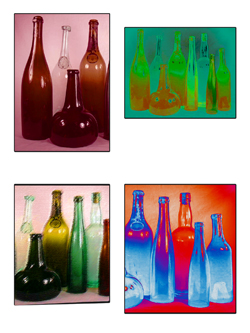
Divide a sheet of mayfair paper to four areas. Paint a simple still life using analagous colour (neighbour colours), warm/cool colour, complementary colours
Complete at home and submit on week 12.
Introduction to Major assignment 1
(Water, fire, air, earth)Week 10 (April 5):
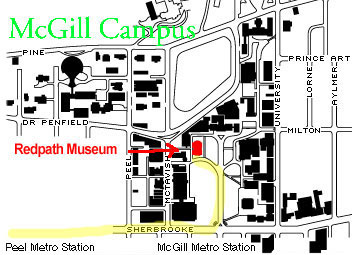
Visit the McGill Redpath Museum
Tuesday, April 5, 2010
9:30 am to 11 am!
Choose one particular cultural object in the Redpath Museum collection to draw.
1. Draw detailed sketches of the object noting any designs and motifs that may be present. (at least 2 to 3 drawings)
2. From your drawings, do a web search to find similar motifs and their purpose in our culture. (In the case of a natural object, determine its history and why, you think, that it is on display)
3. Bring your drawings to class in two weeks (April 19). Write out a short report (1/2 a page) and submit it with the drawings.
That’s all!
Week 11 (April 12):
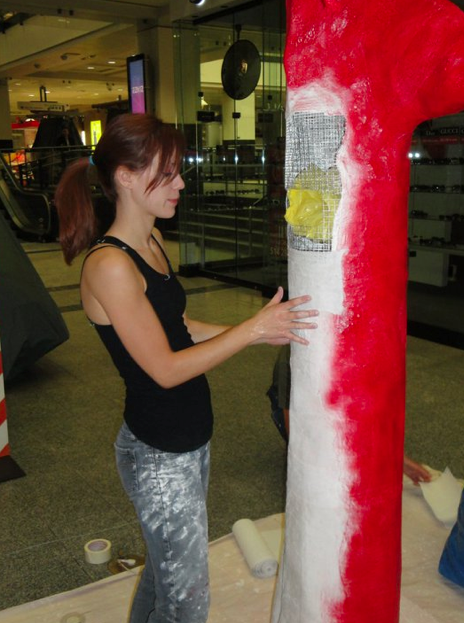
Guest Lecture Annie Briard (for all Visual Arts and Fine Arts Students)
Annie Briard is a graduate of Dawson College Fine Arts.
Her interdisciplinary practice encompasses a vast range of media including painting and drawing, video, animation, sculpture, performance, textiles and installation; her art is deeply rooted in the philosophy of being and environmental relationships and connections.
Her works have been exhibited nationally as well as in Italy, Czech Republic and Beijing. Screenings of her videos have been presented since 2005 in artist-run centres and galleries, notably in Montreal’s Mainline Theatre, Art Mûr gallery, Articule, Studio XX and Nexus, and at the NFB mediatheque (Toronto) in 2008, as well as the Three Shadows Photography Art Centre (Beijing) in 2009 for the “Canadian Cameras at Work” showcase.
Her performances and installations have been featured throughout Montreal, notably including Branchements, a commissioned performance at the Caisse de dépôt et placement du Québec (2008) and Pining for Nuit Blanche at Plum Gallery (2008). In 2009, she participated in a residency in Bass River and her interactive performative installation Fallings was featured at the White Rabbit Arts Festival (Nova Scotia).
Week 12 (April 19):
Painting the
human figure:
Studio work: Painting model in class (10%)
Week 13 (April 26):
Studio work: Painting in class: Model.
Week 14 (May 3):
Major Assignment 1 due.
Studio work: Interpretive analysis and synthesis of written notes.
Week 15 (May 10):
Painting outside of the studio
(May 19, 3:00 pm, absolutely last time for submission of ALL work for credit)
PLEASE REPORT BROKEN LINKS IMMEDIATELY